welp is a quiet inbox for your GitHub review queue, and a tour of each pull request in the order it reads best.
It lives in your terminal. A first release candidate is out: the inbox reads your GitHub today, and the tour and posting come next. Install it with Homebrew.
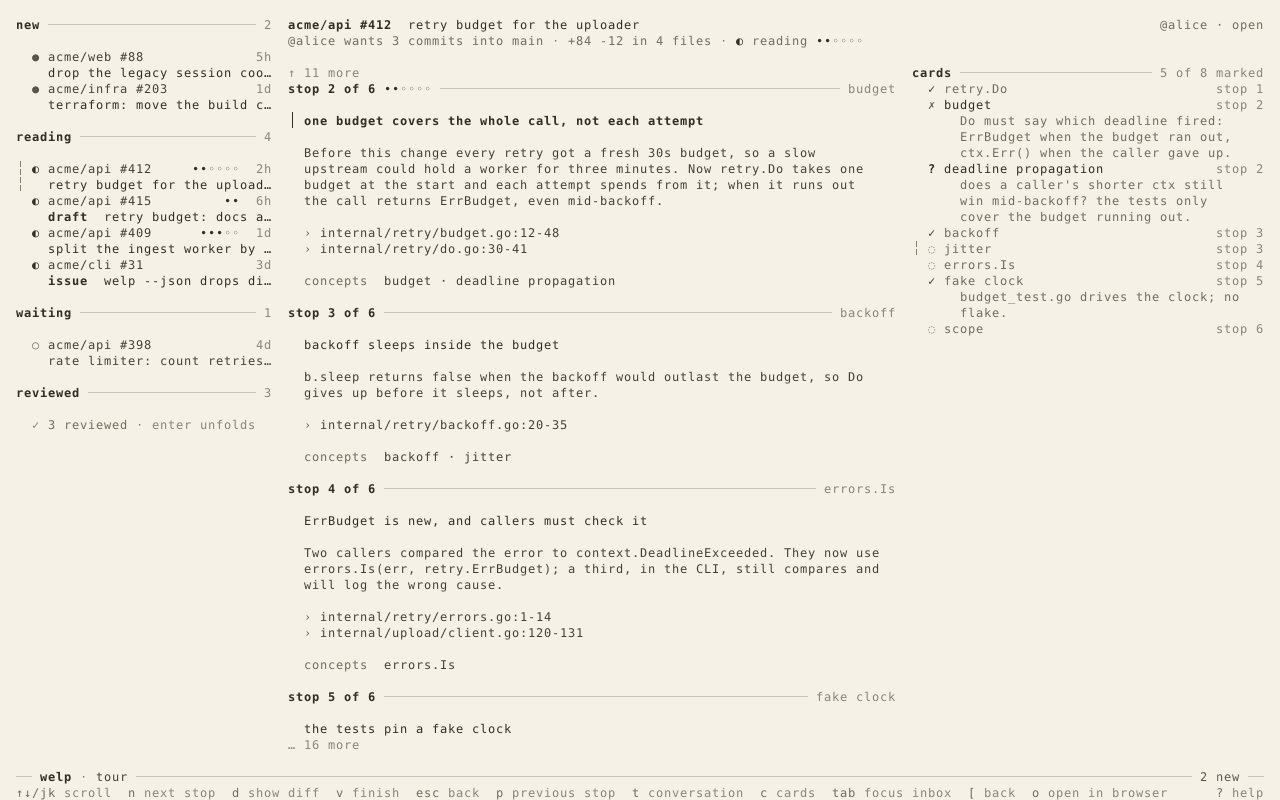
what needs you
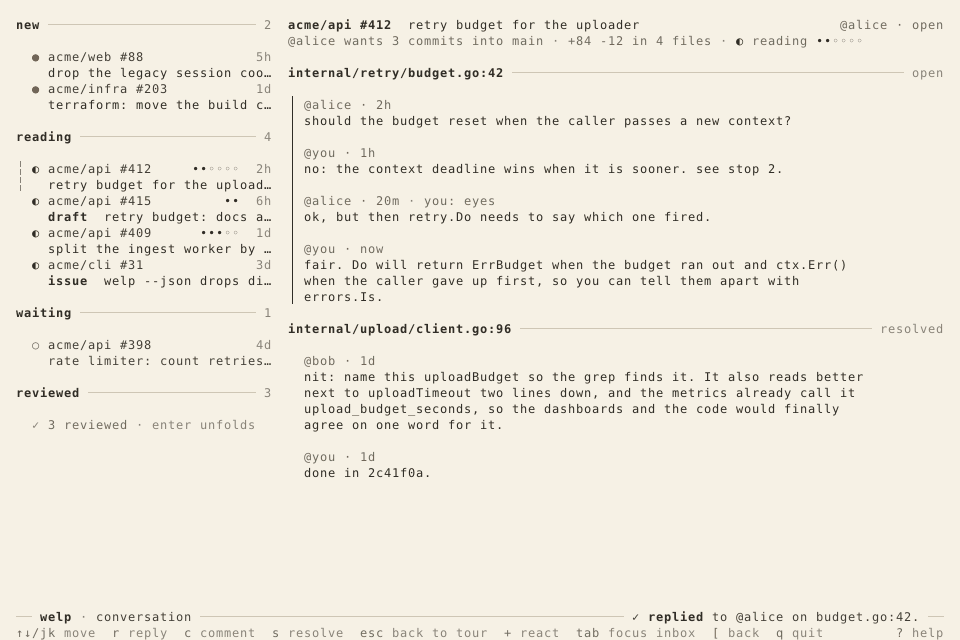
Review requests, the pull requests you opened, the issues and discussions that mention you. welp sorts them by what has happened since you last looked, not by anything you filed, onto four rungs.
Only the top rung has colour. Nothing blinks, nothing counts at you, and an item fades as it settles.
- newsomething changed, and it is your turn
- readingopened, not finished
- waitingthe last word is yours
- revieweddone, until someone pushes
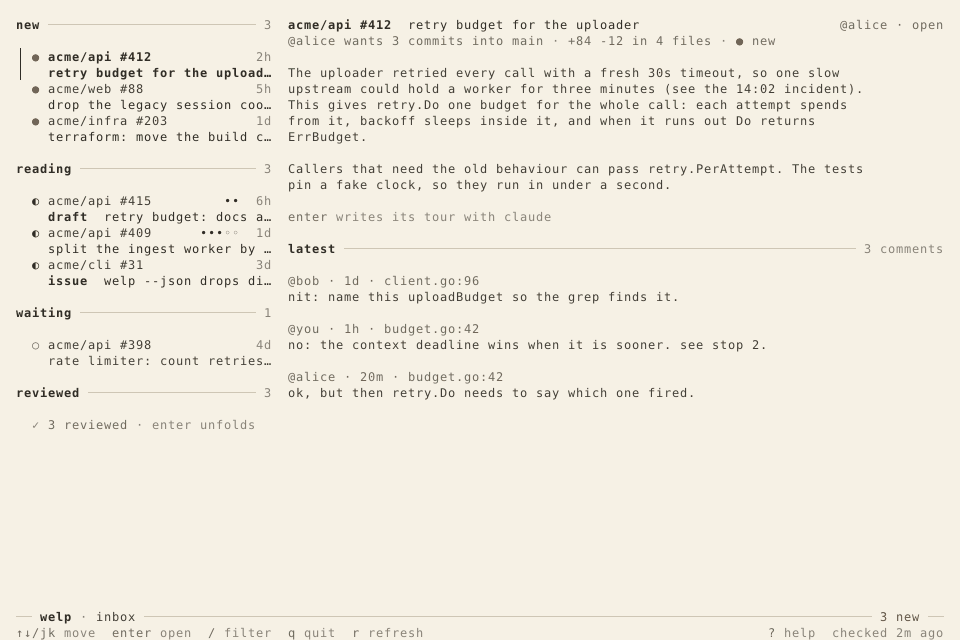
the tour
Open a pull request and the agent reads it first. It hands you the stops in the order that makes sense, which is rarely the order git listed the files. Each stop says what changed and why it matters, names the lines it covers, and the concepts it touches. Its diff is one key away.
The dots beside an item are the tour: one per stop, filled to where you stopped, •••◦◦. Come back tomorrow and it opens where you were.
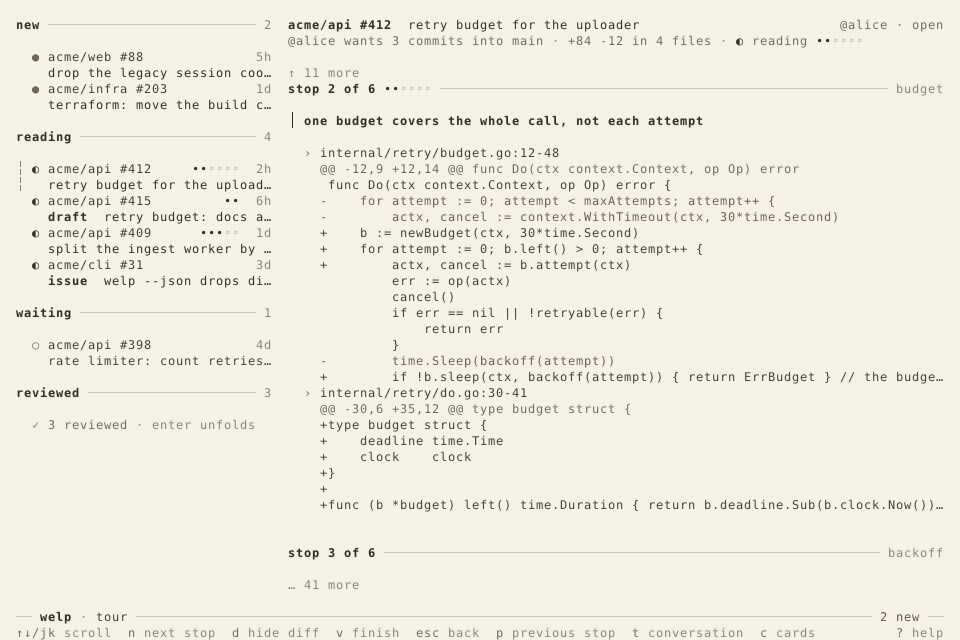
ask in place
A question goes under the stop it’s about: how this fits the code around it, whether it will hold under load, what the other way would look like. One agent session per pull request, so the follow-up remembers the question. Answers stay where you asked them, diagrams included, drawn in box characters.
cards, then one verdict
The tour proposes the concepts the change rests on. You mark each card as you go: fine, a question, or blocking, with a line of why. When you finish, the cards are the review body and you choose one verdict with it in view. Your own pull requests get the same tour and end with ready for review, or not yet.
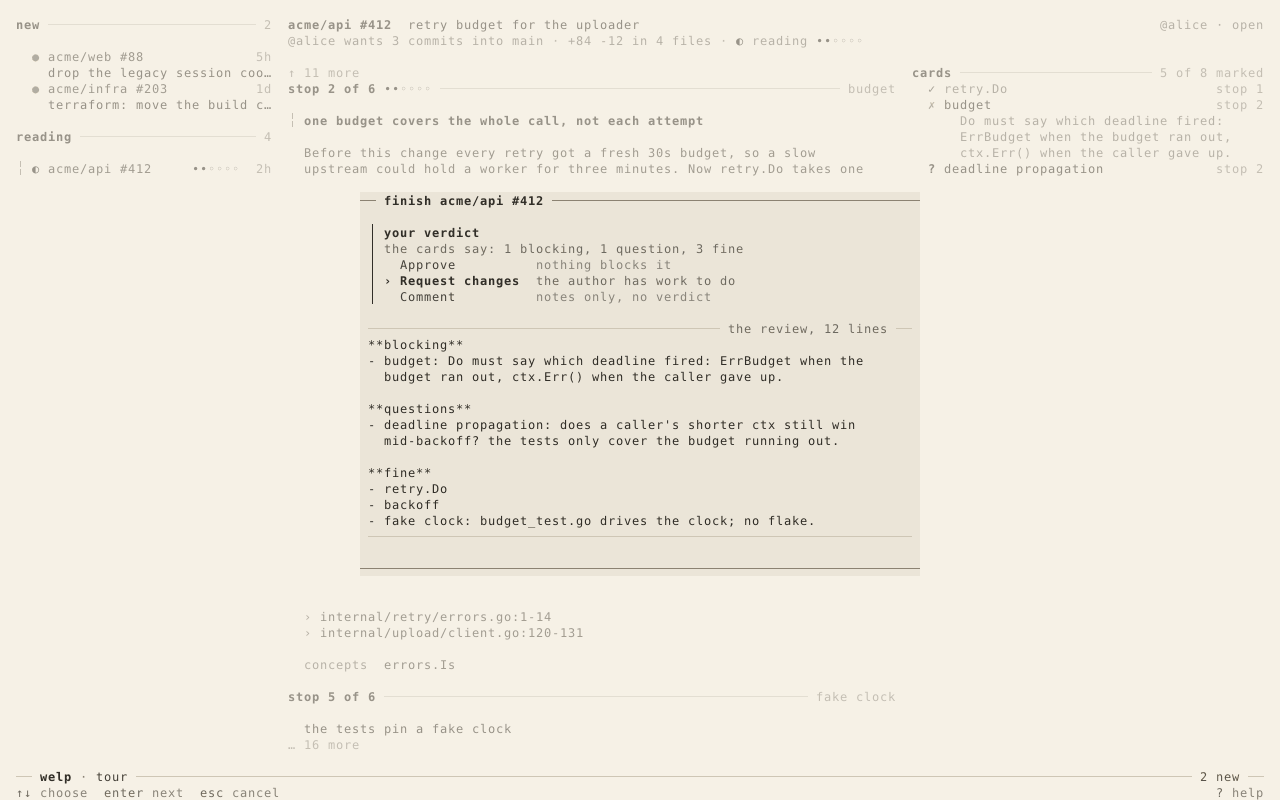
sending is the confirmation
welp doesn’t ask whether you’re sure you meant to reply. The gesture that makes a write confirms it, and what is sent is exactly what you typed. Only what can’t come back asks twice.
| write | confirmed by | and then |
|---|---|---|
| reply, comment | enter | a few seconds to edit or undo |
| react, resolve, mark an answer | a toggle | do it again to take it back |
| close or reopen an issue | it sends | u undoes it |
| post a review | the verdict | the body was in view when you chose |
| delete a commentlater | asks twice | the only dialog, and it starts on cancel |
yours, on your machine
welp signs in with the token gh already stored, so there is nothing new to create. Tours and answers come from the agent you already use, claude, codex, opencode or pi, run in a checkout welp keeps to itself; your own working copies are never touched.
What you read, asked and noted lives in one file on your disk. There is no welp server. Nothing reaches GitHub that you didn’t send.
where it stands
The first release candidate is out. Its inbox is your real GitHub, read with gh’s token, and it sorts itself the way this page says. The tour and the writes aren’t wired to the world yet: a pull request opens on its conversation, and a write says it can’t post.
Run it with -demo and the whole loop plays on a recorded GitHub and a recorded agent, which is where the pictures on this page come from. Next: the claude adapter and posting, then codex, opencode and pi, then a short tour of only what changed when someone pushes after your review.
brew install --cask jrschumacher/tap/welp@rc
macOS and Linux, on Apple silicon, ARM and Intel. A candidate: things will move. When 0.1.0 ships, swap welp@rc for welp.